Home » Blog

How to Avoid Future Shock

By Kim S. Nash
Originally Published December 16, 2011

What’s wrong with how most companies create a business strategy?

C-suites spend a lot of time focusing on execution. The problem is they may not be executing on a full strategy. Too often, a strategic plan is a static document. We have a meeting and write it up, including objectives, goals, time lines and accountability. But then it’s fixed in time until the next time we have a strategic planning session and come up with a new one. We need to make the strategic plan alive in the minds of our people.

If you ask somebody, “What’s your strategic plan?” we don’t want them to say, “Just a minute. I’ll find it on my computer.” That means they’re not living it.

[ Get advice from those who are making decisions and discover innovative products or strategies in CIO's Leadership and Innovation newsletter ]

Traditional strategy focuses on scenario planning. “If this happens, we’ll do that.” But people fail to realize there are two types of trends: hard and soft. Hard trends will happen. Soft trends might happen.

What’s a hard trend?

A hard trend is going to happen whether you like it or not. There are three prime drivers of hard trends: technology, demographics and government regulation. When there’s a law passed, pay attention. It’s loaded with hard trends that give you amazing opportunities if you pay attention. Will we be able to use cell phones and tablets to tap into a Watson-like supercomputer? Yes. Will we be able to use mobile devices to tap into logistics and supply chain systems? Yes. So why are you waiting?

Job Trends: Taking Tech Changes Into Your Own Hands

By WALLACE IMMEN
Published 

Taking tech changes into your own hand.

As bleak as the prospect of a long winter might be, at least you can be sure that it’s going to give way to spring.

It’s a shame you can’t be as certain about an economic rebound, a resurgence in hiring or even whether your job or employer will be secure in the coming year.

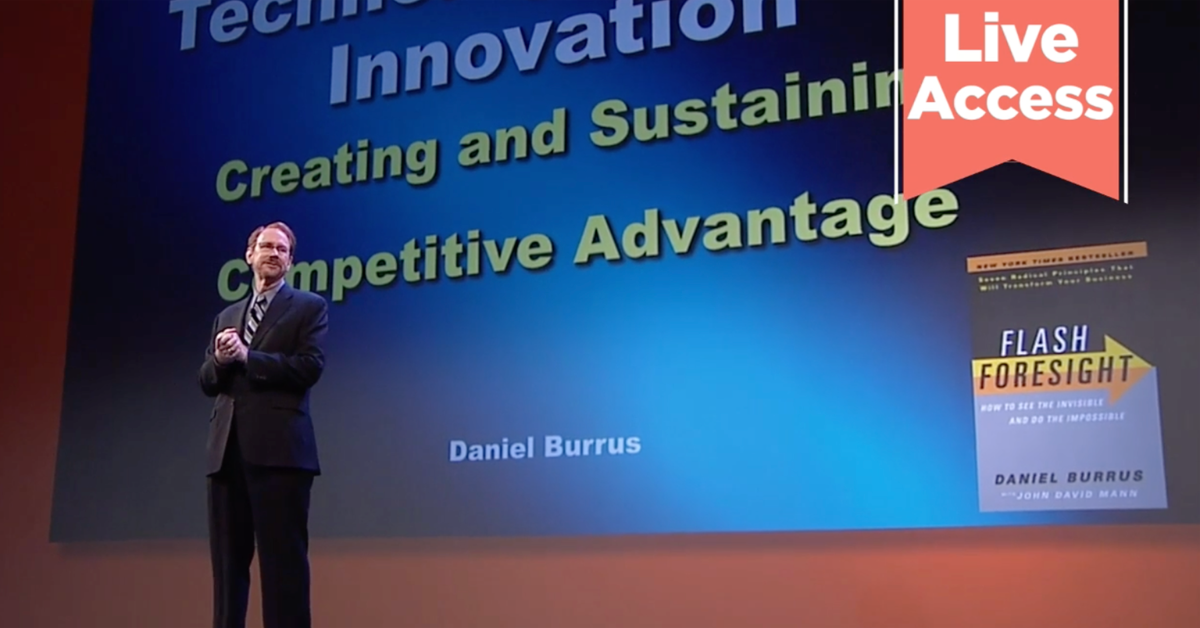
Yet there are changes and trends you can be confident will happen in the near future, and they can be used to design career strategies to weather even the most prolonged economic chill, according to technology trends consultant Daniel Burrus, author of Flash Foresight.(To read an excerpt from the book,click here.)

“A career strategy based on uncertainty has high risk. When the level of uncertainty is high, if you put off making decisions … it can keep you from moving forward both personally and organizationally,” he said in an interview.

“It has been never more important to ask what we can know for certain, and plan from there,” said Mr. Burrus, who is chief executiveofficer of Burrus Research Associates Inc. in Hartland, Wis.

3 Keys Leaders Can Use to See the Future

Please check my recent guest blog post on Mike Figliuolo‘s blog, thoughtLEADERSLLC.com. Originally published on December 14, 2011.

We’re all aware that there are timeless leadership principles that have been true since the dawn of time and that will continue to be valid in tomorrow’s business environment. Things like integrity, honesty, and personal responsibility immediately come to mind. While those are all vital traits, they’re not the leadership traits I’m addressing right now.

In today’s world of technology-driven transformation, leaders need to embrace a new leadership principle if they want their organization to be relevant today and in the future.

In the recent past, leaders have focused on agility—being able to change quickly based on external circumstances because change from the outside-in has been coming at an ever-increasing speed, and it’s only getting faster. Many of these types of changes are driven by technology, but they’re also from our customers, because technology is influencing our customers and changing the way they interact with us.

We also have increasing transparency, meaning your customers and prospects have access to complaints, as well as accolades, through social media and other new forms of communication. All of these changes, which are coming from the outside-in and force agility, cause leaders to react, crisis manage, and put out fires on a daily basis.

Knowing this, it’s evident that simply being agile no longer works. Instead, today’s leaders need to be anticipatory.

When you’re anticipatory, you’re creating changes and driving disruption from the inside-out rather than being disrupted from the outside-in. Disruption is the disruptive technology that changes our world on us and keeps many leaders up at night. Chances are you’ve often asked, “What new technology will disrupt my path to market?” or “What new technology will change how my customers behave?” For many leaders, disruption is a familiar foe.

But realize that disruptive technology is only disruptive if you didn’t know about it ahead of time. And when you’re anticipatory, you can not only see and accurately anticipate those disruptive technologies, but you can use them to create new revenue streams, new products, new services, and new markets. That’s when you drive growth and change from the inside-out so that others have to react to you instead of you reacting to what others are doing. In this scenario, disruption is your friend.

So the question is, how do become more anticipatory?

Continue Reading >

The High Risk of a ‘Wait and See’ Approach

Originally published on ChiefExecutive.net December 9, 2011.

Chances are your company is one of the many taking a “wait and see” approach to one or more business issues right now. The approach plays out like this:

• “Should we redo our website? Let’s wait and see what the competitors do.”
• “Should we expand into a new market? Let’s wait and see what the economy does.”
• “Should we invest in cloud technologies to increase the speed and agility of the organization? Let’s wait and see what new innovations will be released.”

On the surface, taking a “wait and see” approach seems to make sense. After all, we’re dealing with a U.S. and global economy that’s filled with uncertainties. We’re hearing news reports that predict a long and drawn out recovery. We’re witnessing not just rapid technological changes, but major transformations on so many levels. So “waiting and seeing” what happens certainly seems less risky.

In reality, a “wait and see” approach has much more risk than the action being avoided. Here’s why. In the past, when we were going through rapid change (not massive transformation like we’re seeing today), a company could use a “wait and see” approach because it was harder for competitors to develop and deploy new offerings quickly, and it was harder for established competitors to change the game or redefine completely. None of that is difficult anymore.

Today, new competitors can emerge rapidly, and they can even be from another part of the world. Geography is increasingly less of a hindrance. Anyone, at any time, can quickly become more relevant than you because the barriers to entry are low and the ability to scale is fast. Therefore, in a world were the game is changing rapidly, failing to take action—deciding to “wait and see”—can quickly put you on a path of increasing irrelevancy or a rapid demise.

Additionally, with many adopting a “wait and see” approach, the pace of recovery will be very slow indeed.

The Future of TV

In terms of TV, Xbox is doing something that Apple TV has been doing for years, but Xbox is taking it to a new level. With Apple TV you have Hulu, Netflix, and Access. You can play games, watch TV, and read your emails. But the thing that the Xbox is bringing to users is their Kinect system, which includes a 3D video camera combined with voice recognition to allow users to control the screen with their hand and body movements. No mouse and no remote control—just hand and body movements.

This is taking the Xbox on a predictable path. In the late 1980s I predicted that IPTV (internet protocol television) was where we were going. Now here we are. And in the future, IPTV will continue to grow.

Looking at the hard trends around us, it’s clear to me that the real future of television is apps. Have you ever wondered why you can have 500+ cable channels and nothing to watch? It’s because you don’t have AppTV.

To understand how AppTV would work, let’s look at the iPhone. Two people can have an iPhone and have the same service provider. But those two phones would be completely different from each other. Why? Because when you have an iPhone, you customize it for your needs by picking the apps that are significant to you. You turn an iPhone into a MyPhone.

In that same way, with AppTV your TV will be customized for you. Think of it as an iPad big enough to be in your living room. Here’s how it will work: We will be using apps on the TV so that when you sit down to watch, you’ll have a customized viewing experience rather than hundreds of stations you don’t want to watch.

Not only that, but there will be a camera on those TVs, just like the tablets and smart phones have today, and it will use facial recognition. So when you walk in the living room, it will know you are there and will self-configure the right apps for you. If the entire family is in the room, you’ll use your voice to let it know which apps you want to have available.

For example, if your family consists of five people—two adults and three kids—and the dad and one child are in the room, the system will have the apps for those two individuals available for them. The two people can then decide which of those shows they want to watch.

So IPTV and apps is the future of television. And what the XBox is doing today is part of that progression. As the technology progresses, Apple, Google, and Microsoft, as well as other manufacturers, will continually fine tune it, making the future of TV happen today.

How to Maximize Future Trends

Listen to my interview with Alisa Parenti in Wall Street Journal’s, “Money, Markets and More.”


Some Advice for Occupiers: Get Your Act Together

The Occupy Wall Street movement has been in the media for months now. But are they making any progress? Not as far as I can tell.

For any movement or protest to be successful, the demonstrators must have a list of demands. This is where the Occupy movement protesters are lacking and why they’re confusing so many people. Initially, it seemed they didn’t have any demands. The best we could get was that they wanted to create communication with Wall Street and with government because they felt there was none. Then, weeks later, we started getting many different lists of demands. And that’s when the real confusion began.

We started getting too many demands, an ever-changing list of demands, and some over-reaching and unrealistic demands. For example, in one publication they stated 13 demands. In another magazine, I saw 5 demands. In yet another, there were 12. Even more confusing, there were very few repeats between the lists, meaning there were actually dozens of demands, and none of them solid.

So here’s my advice for the protesters: Big lists never get done. A better approach is to pick two or three demands that people can remember; you’re more likely to get them met.

Additionally, when you’re asking for demands, you need to ask for something that can actually happen. For example, in one of the articles published this week about the Occupy movement, demand number four was free college education for all. While I completely believe in education and the value it brings our country, that’s one tough demand to fill. If you’re ready to be occupying all the parks and all of the public places for many years to come, then you can stay with that demand. But it would be better to revise that demand into something that can actually be delivered.

Other examples of unrealistic demands were spending $1 trillion in infrastructure now and outlawing all credit reporting agencies. There were many others.

If the Occupy movement is to merely get a lot of people out on the streets, occupying for an unknown cause, they’re doing a good job. But if they are trying to actually get something done, they need to get their act together. Reduce the list of demands to no more than five and have every single protester able to talk about those five sole demands to the media. And most important, make sure those five demands are actually doable. Until this happens, the Occupy movement will flounder, and it will be more of a news report of how police are trying to move the occupiers.

Now don’t get me wrong…Being able to protest is one of our most cherished rights. So protest and occupy if you feel that’s needed. It’s certainly your right. Just get your act together if you want your efforts to make a difference

All I Really Need to Know I Learned in Waffle House

By Guest Author James Adams

As evidenced by the “Occupy Wall Street” movement and European debt debacles, the pervasive sense of economic malaise that began more than three years ago isn’t fading anytime soon.  The apparent ineffectiveness of stimulus packages and a zero interest rate policy have left Americans understandably skeptical of their government’s ability to return their living standards to pre-recession levels.  Stagnant economic conditions have generated at least one positive development, however: spurring a long-overdue interest in financial education.

After my layoff from a money management firm in early 2009, I decided that I needed an extended hiatus from financial services.  Two years spent apologizing to banks, pension funds, and insurance companies for imploding mortgage securities that my firm had purchased for them had drained my zeal for the profession.  As my growing sense of guilt for my small role in the financial crisis deterred me from pursuing unemployment benefits, I decided to instead work at McDonald’s.  There was just one problem: despite repeated application efforts, they wouldn’t hire me.  Eventually, I was hired as a Waffle House server and assigned to work on the weekend graveyard shift.

No sooner did I land at the diner than I found myself under the tutelage of Edward, one of the restaurant’s only two “master grill operators.”  The mustachioed veteran barely showed thirty-five of his nearly fifty years of age.  An otherwise average build was accentuated by broad shoulders and sinewy forearms.  In addition to cooking, Edward provided trenchant (and usually ribald) commentary on all customer and employee activity.  Beyond entertaining the wait staff with colorful innuendos and euphemisms, he imparted a few career lessons I’ll never forget.

Smartphones Help More Shoppers Be Savvy

Mobile shopping activity increases, forces retailers to improve apps, online services

By Sandra M. Jones, Chicago Tribune reporter

When many Americans enter a store these days, they have three things: a wallet, a shopping list and a smartphone.

Until recently, smartphones did little more than help shoppers find a store location or take a photo of a product to share with friends. A few sophisticated shoppers showed off their shopping apps for checking inventory or comparing prices, but they were few and far between.

Not this year.

As mobile shopping activity increases, the pressure on physical stores to compete instantaneously with online retailers is growing. Two-thirds of smartphone owners shop from their mobile devices, according to a report released Wednesday from Chicago-based digital research firm ComScore Inc. And one of the most common shopping activities is comparing prices, a feature that threatens to take a cut out of bricks-and-mortar stores’ sales and profits.

With a smartphone, a consumer can look over a product in a store, check the price and then buy it online or at another traditional retailer.

“Mobile phones are empowering consumers to find the best prices on the things they want and to compare among merchants,” said Mark Donovan, a senior vice president at ComScore. “We’ve been able to do that on a PC for a long time.”

Indeed, 30 percent of smartphone shoppers research product and price details from their cellphones and 26 percent scan bar codes to compare prices among various retailers, ComScore said. That figure is expected to grow as more shoppers rely on smartphones as their personal shopping concierge.

It’s Time to Transform the US Postal Service

The United States Postal Service has been doing poorly, financially, for years. With the advent of emails and electronic bill payments there’s been a dramatic drop in the use of the postal service, yet their expenses have increased. So it’s no surprise that they’ve recently announced some big cutbacks to help them rein in costs.

In the future, will more people turn to online bill payments and email communications? Absolutely. That’s a hard trend. And starting in 2012, thanks to mobile banking and mobile payments, we’ll see people turning their cell phones into a way of paying bills. Additionally, Netflix, one of the biggest users of the US Postal Service, will soon be streaming movies to your phone, tablet, and digital TV rather than mailing DVDs. As processing power, bandwidth, and storage continue to accelerate exponentially, the concept of DVDs coming via the mail will be obsolete.

Now, I admit that it’s nice to get a handwritten letter. Additionally, you can’t email packages. But we don’t need that much mail anymore. And with FedEx and UPS being competitive in the package delivery markets, what’s the US Postal Service to do?

One suggestion is to get into the email business. Believe it or not, but the USPS has very sophisticated technology. In fact, they likely have the most advanced scanning technology in the world. Just think of all of the packages and letters they have to scan with handwriting recognition software—even items with the sloppiest and most illegible handwriting get to the right place.

So they have amazing technology…and we have emails that are loaded with spam. What if the USPS created a secure email system for the nation that has the highest level of spam filtering?  Since it’s our government, perhaps they could connect with the Department of Defense to make sure we get good filtering, get rid of spam, eliminate viruses, and devise a national email verification system. This way we know for certain that our emails are from the companies they claim to be from and are not a phishing scheme.

Would everyone in the US use it? No. But if it’s a high value service, most corporations and businesses will jump onboard and pay handsomely for the service.

Finally, with the layoffs the USPS is planning, estimates show that by 2015 there’ll be 120,000 fewer Postal Service employees. That’s a soft trend, since many things can still affect this estimate. But rather than just lay people off, what about retraining those workers so they can get jobs in something that is growing? Putting money toward retraining and re-educating would be well-spent so the unemployment system isn’t strained even further.

Ultimately, the USPS has the opportunity to create some amazing new value for United States citizens. By generating income from e-business and retraining workers, they could positively shape America’s future rather than cling to the past.

Security Stocks

Last year 85% of the phones sold globally were Smartphones – and, of course, that percent will go up this year.  As a matter of fact, it won’t be long, and we won’t have dumb phones.

What is the difference between Smartphones and dumb phones? The answer is the web browser.  If you have access to the Internet, your phone is now smart.  A quick way to tell if you have a Smartphone or a dumb phone.

Smartphones give you access to the Internet, which of course then gives you access to apps. They have email, access to the cloud, and many other capabilities, including the ability to watch TV, & listen to radio.

That phone, then, is transformed into a multifunction utility, almost like a mobile living room, giving you more than what you would normally do on your computer.

This hard trend that will continue and as that happens, we have GPS as part of all phones, and we have people leaving their systems on and giving permission for apps to use location-based tracking, so that they can serve you in a better way. Privacy will be stretched once again.

I think what we’re doing is really just seeing something that’s been a long trend, and it’s harder and harder to manage our own privacy with the wide-scale acceptance of social media.

It is increasingly difficult to manage your privacy.  At some point, the only way you’re going to manage your privacy is to unplug.  And yet, you won’t be able to unplug because everything else, everything that you do and need will be plugged in.

Let’s face it, if we knew exactly what was happening with the movement of all people and their phones, just from being in cars, we’d be able to tell where congestions are taking place. You would be able to get better routing ahead of time so that traffic could move better.  You could get routes that would give you better gas mileage.  There could be a lot of positive aspects to being monitored where you are at any given time. But, once again, the downside is privacy issues.

GDP

We just found out that the third quarter GDP has been revised down from 2.5% to 2%.  Yet, at the same time, corporate profits have been revised up.

Several people have been asking, “How can profits for corporations be going up and yet GDP is going down from where we thought it would be?”

Of course, all you have to do is see that there is a continued Wall Street recovery as we have a continued Main Street recession.  We still have, for the most part, a jobless recovery.  Now it’s not completely jobless, but we’ve not been producing the jobs that we’ve wanted to produce.  We see companies that instead of hiring, are saying, “Well, we can do more with less,” meaning, “We can use technology to do things that we needed people for in the past.  And instead of hiring back all of those people now that we’re starting to increase our profitability, maybe we can use technology instead and just not hire those people back.  We’ll do, again, more with less people, instead of more with less money,” which is what more with less used to mean.

So, in order to break that issue of a jobless recovery, we must realize the hard trends of the transformations that are taking place, and that we are, indeed, transforming how we sell, how we market, how we communicate, collaborate, innovate, train, and educate. That represents amazing opportunities for those that will see it and take action on it.


Sales Trends and Holiday Sales Trends

As we look at regular sales trends, holiday sales trends, and Christmas shopping trends, we have to be able to separate the hard trends (things we know will happen) versus the soft trends (the things that might happen).

Did we set a record in sales on cyber Monday? That’s a soft trend.  It looks good.  There’s a lot of pent-up demand from the last several years, people were being very careful about how much they were spending.  They will still be careful, but I think they’re feeling a little more optimistic.  So, it’s likely that they’ll spend more, but that is a soft trend.

What is a hard trend?  Something we do know is that technology will be used more and more to make purchases every month and every year.

This year, once again, a new record in the number of people that are purchasing online will be set. The number of people that are using Smartphones to do their shopping and their comparison shopping, using apps that they can scan a barcode and get the information not only on the product and the sales price, but also instantly compare it with nearby physical stores as well as online stores, to make sure they’re getting the best price, so they can make a decision on the moment.

We’re going to see shoppers increasingly pulling out their Smartphones, doing scans, checking out deals, and making purchase decisions. Those purchase decisions will not be based on what’s in the store, but what’s on their phone, and then the decision, “Do I want to buy in the store or do I want to buy right now, from the phone?  Because I found what I like and now I’m going to purchase it.”

What is happening now,  is that the retail stores are becoming a place to find and preview products, because people can see the actual product.  But will the customer buy them there, just because they are there?  In the past, the answer was yes, but now, today, it’s “Not necessarily.  I got a much better price.  I’m going to buy it somewhere else.  But I’m making my purchase decision in the store.”

The shift here is that the purchase decision is in the store, but not necessarily to buy what’s in front of them in the store. This is a significant shift that can have an impact on retailers this year.

Did we have more people than ever participating in Cyber Monday?  The answer is yes.  Did we set sales records?  Well, it would seem so, but that’s a soft trend.

Will this holiday season be better than last year and the year before?  Again, that’s a soft trend.


Reaction to Burrus

Daniel Burrus' Strategic Insights Blog


Trends for 2012

Content on this page requires a newer version of Adobe Flash Player.

Get Adobe Flash player


Watch Dan Burrus Videos

The Foresight Package


Visit our download center

Visit our News and Media section

See why clients rave about Burrus Research
Back to top